Streamlining Legal Document Workflows for Indian Startups: NDA & Founder Agreements
Streamlining Legal Document Workflows for Indian Startups: NDA & Founder Agreements
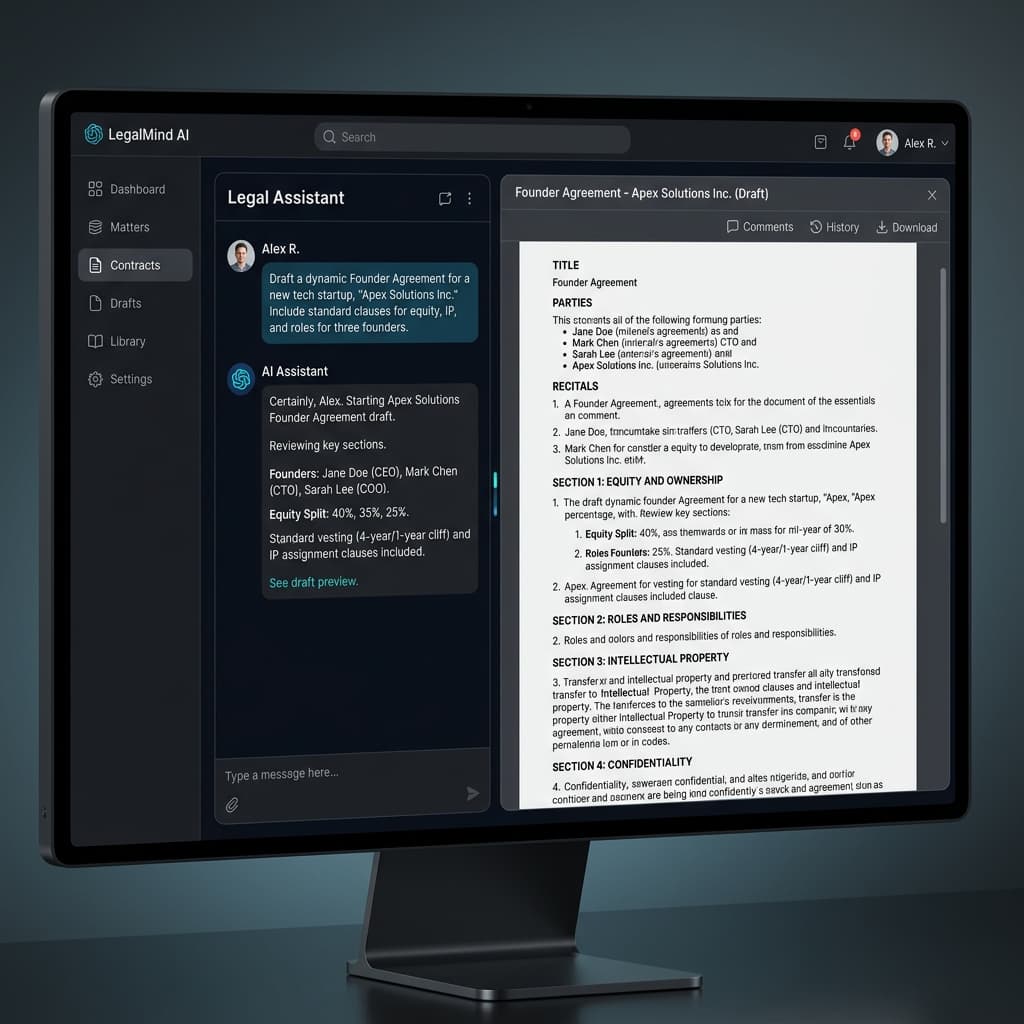
Launching a startup in India is an exhilarating journey, characterized by rapid innovation, relentless networking, and intense problem-solving. However, amidst the excitement of building a product and acquiring customers, founders often sideline a critical component of their business foundation: Legal Documentation.
Relying on generic templates downloaded from random websites can lead to disastrous consequences. In India, business agreements are governed primarily by the Indian Contract Act, 1872, and disputes are resolved under specific jurisdictions that must be explicitly defined in your contracts.
In this article, we will focus on two of the most critical documents for any early-stage startup—the Non-Disclosure Agreement (NDA) and the Founders' Agreement—and explore how startups can use AI platforms like DocuVerse to streamline their creation without incurring massive legal bills.
1. The Non-Disclosure Agreement (NDA)
An NDA is often the very first legal document a startup executes. Whether you are pitching to an angel investor, hiring a freelance developer, or discussing a partnership with a vendor, you must protect your Intellectual Property (IP) and trade secrets.
Key Elements of a Valid NDA in India:
Under the Indian Contract Act, an NDA is a legally binding contract enforcing confidentiality. For it to be enforceable, it must contain:
- Definition of Confidential Information: Do not be vague. Clearly define what constitutes confidential data (e.g., source code, customer lists, financial projections, or algorithms). Just as importantly, state what is not confidential (e.g., information already in the public domain).
- Obligations of the Receiving Party: Specify that the receiver cannot use the information for their own benefit or share it with third parties without written consent.
- Term of Confidentiality: How long must the secret be kept? While some information requires perpetual confidentiality, most NDAs stipulate a term of 2 to 5 years.
- Jurisdiction and Dispute Resolution: If a breach occurs, where will the dispute be resolved? You must include an exclusive jurisdiction clause (e.g., "Courts of Bengaluru shall have exclusive jurisdiction"). Many startups also prefer adding an Arbitration clause under the Arbitration and Conciliation Act, 1996, for faster dispute resolution outside standard courts.
Drafting NDAs at Scale
Startups need to issue NDAs constantly. Having a lawyer draft every single one is financially unviable. Using the DocuVerse AI Assistant, a founder can simply input: "Generate a mutual NDA for a software development partnership, governed by the laws of India, with exclusive jurisdiction in Delhi, and a confidentiality term of 3 years." The AI will instantly generate a customized, legally sound draft.
2. The Founders' Agreement
While an NDA protects you from outsiders, a Founders' Agreement protects you from yourselves. Many promising Indian startups collapse not because the product failed, but because the founders had a falling out over equity, roles, or vision.
A Founders' Agreement is a contract between the co-founders of a company that outlines the rights, responsibilities, liabilities, and obligations of each founder.
Critical Clauses to Include:
- Equity Breakdown and Vesting: This is the most crucial clause. Equity should almost never be given upfront. It should be subject to a Vesting Schedule (typically a 4-year vesting period with a 1-year 'cliff'). This ensures that if a founder leaves early, they do not walk away with a massive chunk of the company.
- Roles and Responsibilities: Clearly define who is the CEO, CTO, etc., and what their day-to-day operational responsibilities entail.
- Decision-Making Authority: How are major decisions made? Is it a simple majority, or do certain critical decisions require unanimous consent?
- IP Assignment: Every line of code written, every logo designed, and every business plan drafted by the founders before the company was officially incorporated must be legally assigned to the company. Without this clause, individual founders might claim personal ownership of the startup's core assets.
- Exit Strategy (Good Leaver vs. Bad Leaver): What happens if a founder wants to leave, or is forced out due to misconduct? The agreement must define the terms under which their vested shares are handled or bought back.
3. The Modern Legal Workflow: AI & Automation
The traditional workflow for startup legal documents involves endless emails with lawyers, waiting days for drafts, and paying premium hourly rates. This friction slows down business operations.
Here is how modern Indian startups are streamlining this workflow using DocuVerse:
Step 1: Instant AI Drafting
Instead of waiting for a lawyer to draft a standard NDA or an employment contract, founders use the DocuVerse AI Assistant. By selecting a template and providing a few bullet points of context, the AI generates a customized draft tailored to Indian legal standards in seconds.
Step 2: Secure Collaboration and Formatting
Once the draft is ready, it often needs to be shared with co-founders or the opposing party for review. Using the Conversion Hub, founders can instantly convert the Markdown or Word draft into a polished, uneditable PDF.
Step 3: Security and Privacy
Startups deal with highly sensitive data. When sharing term sheets or financial projections, founders utilize Document Guard to apply robust AES-256 encryption, add custom watermarks to deter leaks, and redact sensitive metadata before sharing the files externally.
Conclusion
Legal documentation should act as a robust foundation for your startup, not a bottleneck that slows down your growth. By understanding the core requirements of the Indian Contract Act and leveraging modern AI tools, founders can take control of their legal workflows.
Protect your IP with airtight NDAs, align your founding team with a comprehensive Founders' Agreement, and execute faster than your competition.
Ready to streamline your startup's legal operations? Explore the DocuVerse AI Assistant today and start drafting smarter.