The Future of E-Courts in India: Digitizing Case Files Using Secure OCR Technology
The Future of E-Courts in India: Digitizing Case Files Using Secure OCR Technology
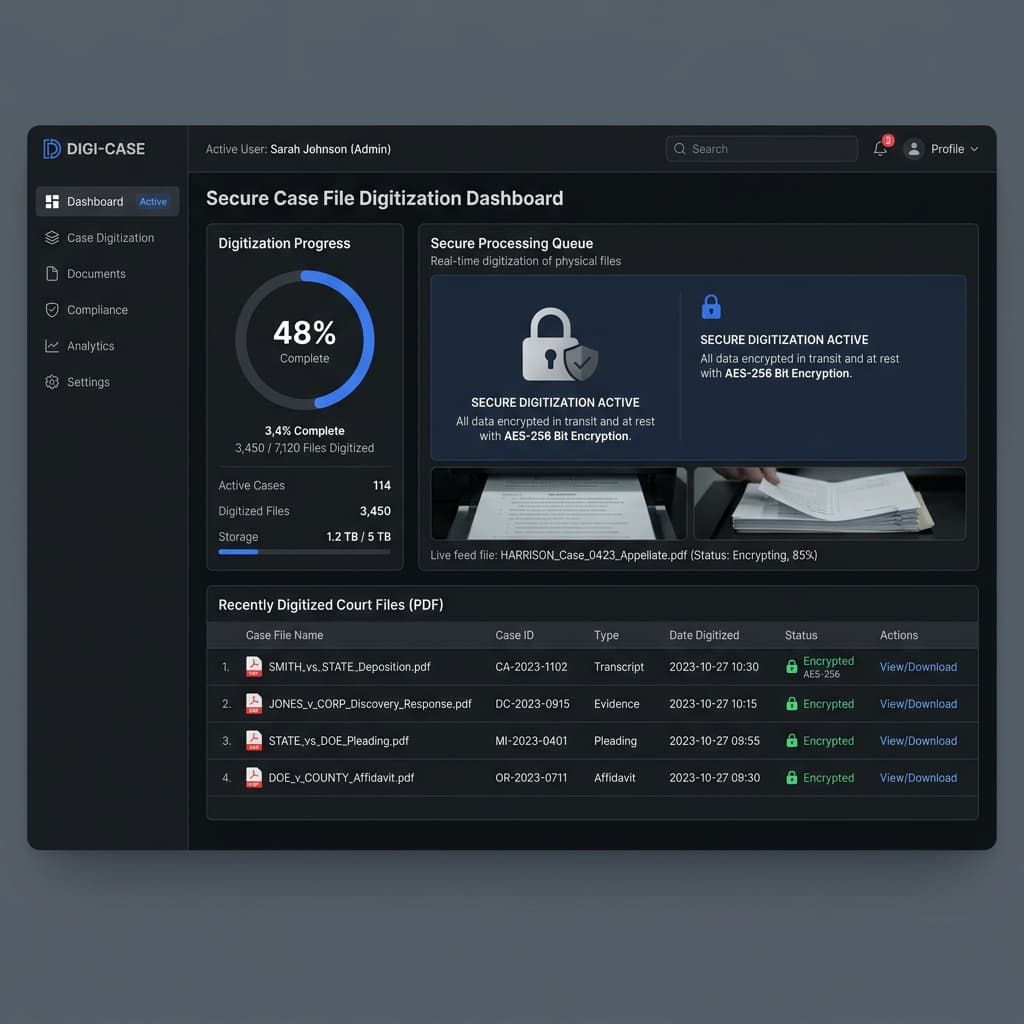
The Indian judiciary is one of the largest and most complex legal systems in the world. With over 40 million pending cases across various District Courts, High Courts, and the Supreme Court, the physical management of paper-based case files has become an insurmountable logistical nightmare. Rooms overflowing with deteriorating files, lost evidence, and significant delays in retrieving historical judgments have historically hampered the delivery of justice.
To combat this, the Government of India, alongside the Supreme Court's e-Committee, launched the e-Courts Mission Mode Project. A central pillar of Phase III of this project is the complete digitization of court records.
However, transforming a mountain of physical paper into a searchable, secure digital database requires far more than basic scanning. It requires advanced Optical Character Recognition (OCR), secure artificial intelligence, and strict adherence to the Information Technology Act, 2000. In this article, we explore how secure OCR technology is shaping the future of Indian e-Courts and how platforms like DocuVerse are leading the charge.
1. The Monumental Task of Digitization
Digitizing a court's archive is not merely about archiving; it is about accessibility. When a judge or a lawyer needs to reference a 15-year-old property dispute or a criminal appeal, they must be able to search for specific keywords, witness names, or legal citations within seconds.
Why Standard Scanners Fail
When a physical document is simply scanned, the resulting PDF is essentially a photograph of the page. It is a 'flat' image. You cannot press Ctrl+F to search for a word, nor can you copy a paragraph to paste into a new legal brief. For the e-Courts system to be effective, every single scanned page must be converted into machine-readable text.
The Role of Advanced OCR
This is where Optical Character Recognition (OCR) becomes critical. OCR software analyzes the image of a scanned document, identifies the shapes of the letters, and translates them into selectable text.
However, Indian court documents present unique challenges:
- Poor Quality Originals: Many older files feature faded typewriters, smudged ink, and brittle, yellowing paper.
- Multilingual Content: Case files frequently contain testimonies and evidence in regional languages (Hindi, Marathi, Odia, Tamil) mixed with English legal terminology.
- Complex Formatting: Court documents often have complex tables, margin notes, and judicial stamps that confuse basic OCR tools.
2. Multilingual OCR: Bridging the Language Gap
The lower judiciary (District and Sessions Courts) heavily relies on regional languages for testimonies, FIRs, and localized evidence. A robust digitization strategy must account for this linguistic diversity.
The DocuVerse OCR Engine is specifically engineered to handle the complexities of Indian scripts. By leveraging machine learning models trained on vast datasets of regional typography, the AI can accurately extract text from documents that would otherwise be misread by western-centric OCR software.
For example, if an FIR originally filed in Hindi is submitted as evidence in an English-speaking High Court, the [DocuVerse OCR engine](/dashboard/ocr-engine) can extract the Hindi text flawlessly. Subsequently, utilizing the AI Translation tool, the document can be contextually translated into English, ensuring that no legal nuances are lost in translation.
3. The Legal Validity of Digitized Court Records
A critical question arises: Are these digitized, OCR-processed files legally admissible in a court of law?
The Information Technology Act, 2000 provides a robust legal framework for the digitization of records.
- Section 4 grants legal recognition to electronic records, stating that if a law requires information to be in writing, the requirement is satisfied if the information is rendered in an electronic form.
- Section 7 explicitly allows for the retention of electronic records. It states that documents requiring retention by law can be maintained electronically, provided they accurately reflect the original document and remain accessible for future reference.
Furthermore, the Indian Evidence Act, 1872 (and its successor, the Bharatiya Sakshya Adhiniyam), includes specific provisions (like Section 65B) that govern the admissibility of electronic evidence, ensuring that digitally signed and securely maintained digital records hold the same weight as their physical counterparts.
4. Security and Confidentiality in the Digital Era
Court records contain highly sensitive information, including identities of minors, victims of sensitive crimes, and confidential corporate financial data. The digitization process must not compromise this security.
When utilizing OCR technology, courts and legal professionals cannot rely on public, unencrypted cloud services where data might be intercepted or used to train public AI models.
Military-Grade Document Security
Platforms designed for the legal sector must prioritize zero-trust security architecture. For instance, the DocuVerse ecosystem employs AES-256 encryption for all data at rest and in transit.
Furthermore, tools like Document Guard empower legal clerks and lawyers to apply dynamic watermarks, restrict printing, and permanently redact sensitive metadata before a digitized file is uploaded to the central e-Courts repository or shared with opposing counsel.
5. The Workflow of the Future
Imagine the daily workflow of a lawyer operating in a fully digitized e-Court ecosystem:
- Instant Retrieval: Instead of waiting weeks for a clerk to locate a physical file in a dusty archive, the lawyer searches the e-Courts database and retrieves the OCR-processed PDF in seconds.
- AI Summarization: Faced with a 500-page judgment, the lawyer utilizes the DocuVerse AI Assistant to instantly summarize the core arguments and the final verdict, saving hours of manual reading.
- Drafting: Using the summarized precedents, the lawyer drafts a new application, converts it to a secure PDF via the Conversion Hub, and e-files it directly with the court.
Conclusion
The digitization of the Indian judiciary through the e-Courts project is not just an administrative upgrade; it is a fundamental shift towards accessible, transparent, and rapid justice.
As physical files give way to electronic databases, the reliance on secure, multilingual OCR technology will only grow. By embracing AI and robust encryption, tools like DocuVerse are helping legal professionals navigate this digital transition smoothly, ensuring that the law keeps pace with technology.
Prepare your practice for the future. Explore the DocuVerse OCR Engine and integrate secure, AI-powered digitization into your legal workflows today.